This AI-assisted article was approved by Volker Cesinger. It presents his personal perspective and is not an official Checkpoint Systems publication.
- Return
- Cleaning recorded
- Professional acceptance
- New contents
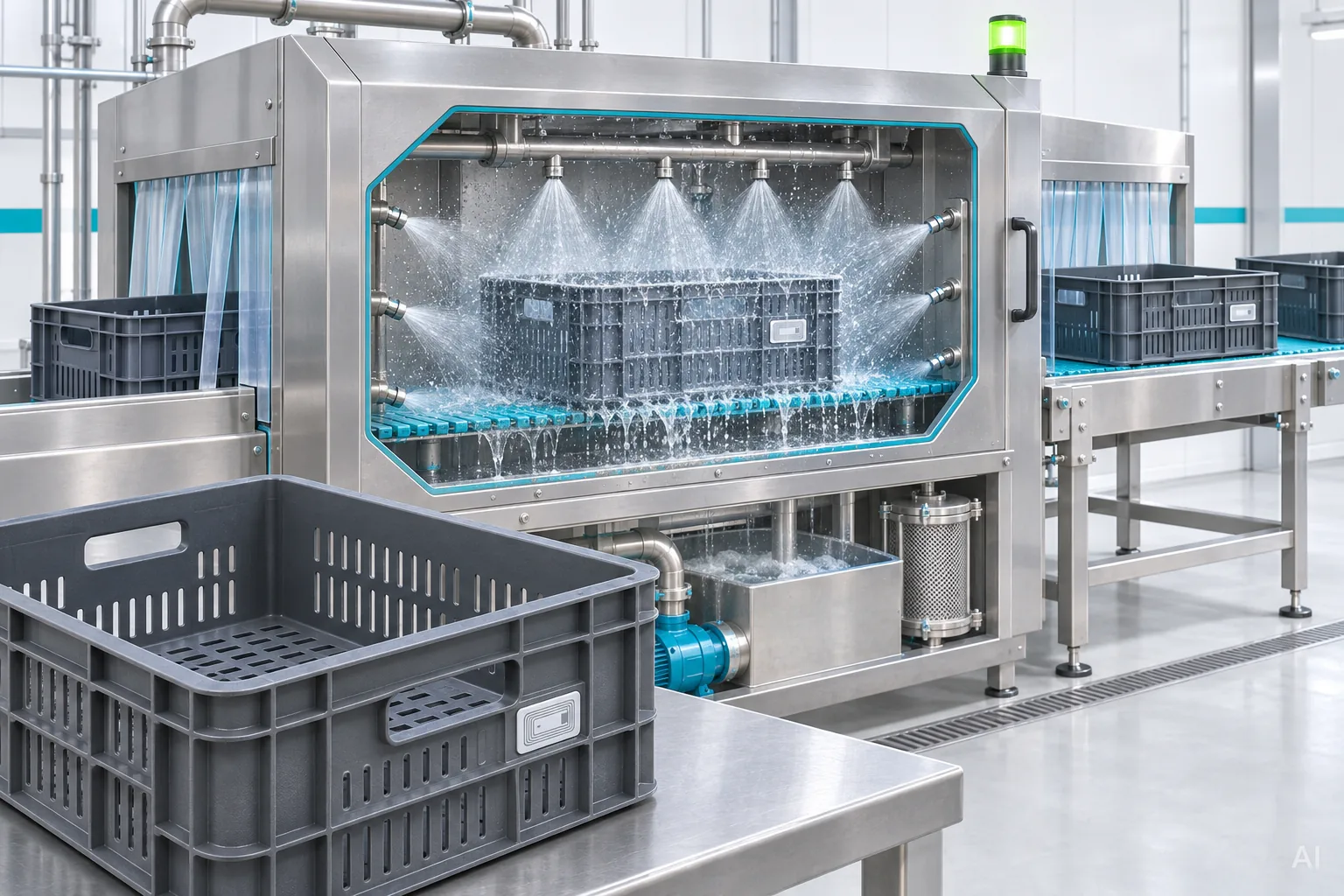
A crate leaves the washing line clean, its RFID label responds and the system marks it available. That looks straightforward. At least three questions need separate answers: which crate is this, what is its cleaning and acceptance status, and which contents may now be associated with it? I would design a reusable-container pilot so those answers remain traceable after tag replacement, rework and an interrupted connection.
Persistent identity belongs to the crate
A container's identity should not change with every filling. Its cargo is a time-limited association. A physical label can also be replaced without losing the container's operating history. The data model therefore needs at least a container reference, current tag association, validity period and documented changes.
Our synthetic example uses the operational reference SYN-CRATE-001. This readable test name is not a proposed EPC encoding. Yesterday the container carried batch A; today it has returned empty. The historical association may remain in the archive, but must no longer appear as current contents. Reading the EPC again does not solve that distinction.
On replacement, old and new tags are deliberately associated with the same container reference. The old tag must not subsequently appear as a second active container. When identity cannot be transferred reliably, the process needs documented investigation rather than a silent new record that loses history.
The complete label experiences the process
Durability involves more than chip and antenna. Carrier, protective layer, adhesive, edges, substrate and placement are parts of the test object. Spray pressure, chemicals, temperature changes, drying, stacking and contact can cause different faults. Water resistance alone does not specify an entire industrial washing process.
Checkpoint's current catalogue presents Santanna Super H2O for washable transport crates and Pali H2O for serving trays. These make the task tangible. The illustrated 50 washes are example container data, not a guaranteed service life. Before recommending a product, I would obtain the approved conditions for the actual label construction. Inlay dimensions are not automatically the dimensions of the finished protective label.
Represent the cycle through defined states
A practical proposed model distinguishes return, awaiting cleaning, cleaning performed, professional assessment, available, filled and quarantined. Before the pilot, agree which transitions may be recorded automatically. Not every operation needs identical states, but their meaning must be unambiguous.
- An arrival read confirms capture at the return point, not a successful wash.
- A machine signal may document a process step, but does not independently establish hygiene.
- A successful radio check confirms readability in that setup, not food condition.
- Only the designated acceptance step permits association of new contents.
This separates technical function from professional responsibility. If a quarantined container is accidentally read at filling, the workflow should create an exception rather than overwrite its status merely because it was detected.
A small trial with explicit limits
For initial functional investigation, I would choose one container construction, a documented label revision and the intended wash process. A synthetic starting plan might use 30 labelled samples, checked before washing and after 1, 5 and 10 cycles. These are neither statistically justified minimum quantities nor a service-life demonstration. They help reveal early failure patterns; later qualification must follow actual use.
Each sample has its own history. Record appearance, attachment and a defined radio check before and after each checkpoint. Deliberately distinguish wet, dry, empty and intended filled conditions. Sequence and unchanged reader configuration belong in the record. Increasing power or holding a problematic crate differently changes the trial and must be documented.
An untreated reference helps distinguish changes in the capture system from changes in labels. A deliberately quarantined test object should also pass through the exception route. A useful trial demonstrates the intended blocks as well as the normal workflow.
Count more than successful reads
At each checkpoint, compare expected containers with actually associated identities. Repeated responses from one crate are not additional successes. Record unwanted neighbouring reads, incorrect cargo associations, visible detachment, manual rework and exception handling time. An average must not hide a repeatedly failing sample.
A missing response does not immediately identify label, placement, moisture, zone or processing as its cause. Failure capture therefore includes a controlled cross-check. The container remains quarantined or is manually resolved according to the agreed procedure. Repeating until the first success is not an adequate acceptance route.
Exercise four exceptions deliberately
First, a recognised crate still has an active old cargo association: new filling waits until it is deliberately closed. Second, a label is partly detached but still responds: the radio read must not override visible damage. Third, a tag is replaced: both identifiers and responsibility for the change are recorded. Fourth, the central connection fails: local events need timing and restart rules; synchronisation must not invent another wash or another cargo association.
Operations, quality and IT should assess these cases together. Before the trial, establish who accepts the container professionally, who provides technical support and who removes quarantined crates from circulation. A role on an organisation chart is insufficient when nobody is available during a shift.
Connect economics to actual circulation
Costs include procurement, attachment, inspection, failures, replacement, integration, rework and actual container use. Fewer missing crates and less manual searching are potential benefits, not measured savings without a baseline. The pilot should also establish whether return movements generate sufficiently complete events to support decisions.
I would not conclude with label passed alone. The decision should identify the accepted container, label, placement and process combination, its restrictions and the changes requiring reassessment. Retain the original trial history. A different adhesive or altered wash chemistry can then be evaluated against a traceable starting point.
Next step
Describe one complete cycle, including cleaning, acceptance and new cargo association. The companion worksheet keeps test objects, exposure conditions and exceptions separate. Start with food and reusable-packaging fundamentals and material comparison, or discuss a bounded pilot.
Sources and interpretation
- Checkpoint inlay catalogue, H2O and Super H2O examples, not a general durability certificate.
- GS1 EPCIS, standardised event-data framework; the proposed states are not a mandatory EPCIS state list.
- Container reference, sample quantity, checkpoints and exceptions are original synthetic planning aids, not findings from a customer project.