WE are RFID · Edition 24
Why self-checkout needs new security and process logic – and how RFID, EAS, data and store processes can help balance customer experience and loss prevention.
White paper
Edition 24
Part of the WE are RFID series.
Personal perspective and transparency
This whitepaper is my personal editorial perspective on the RFID topic. It is not an official Checkpoint Systems publication or a manufacturer brochure. AI-assisted tools may have been used for structuring, translation or language editing. I, Volker Cesinger, reviewed and approved the content, sources, statements and publication.
Executive summary
Self-checkout is intended to make shopping easier, faster and more flexible. At the same time, SCO is changing the checkpoints in the store. The classic checkout contact is reduced, customers scan themselves, store teams monitor several processes in parallel and errors or manipulation are more difficult to detect.
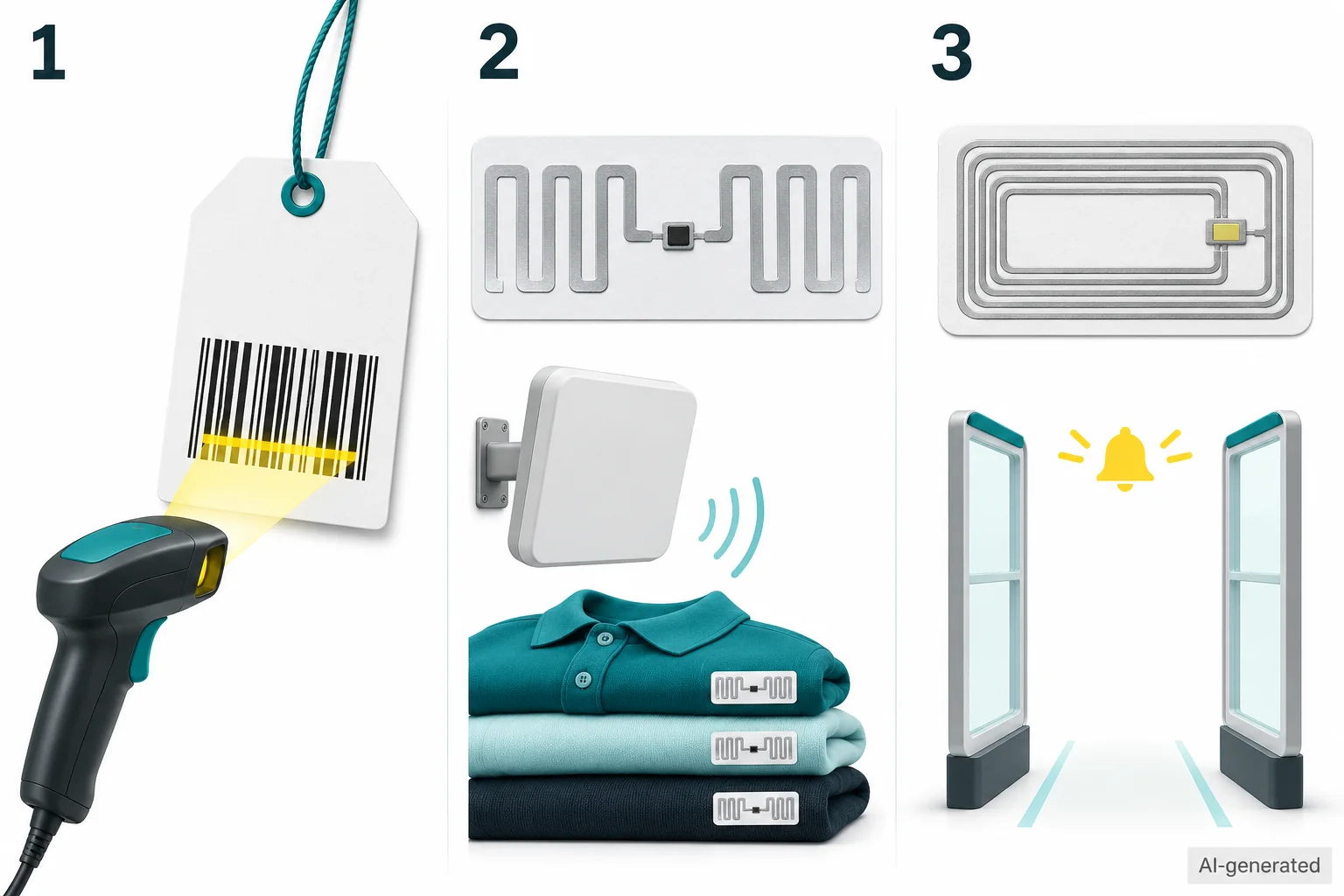 AI-generated illustration
Three capture principles with different roles. AI-generated concept illustration.
Diagram key: Self-checkout and RFID: How to bring convenience and control together
- Barcodes are read optically and can also carry serial numbers.
- UHF RFID combines an identity with radio-based capture.
- Classic RF article surveillance uses a resonant label for an alarm decision, normally without a digital item identity. These are schematic components, not specific product recommendations.
The ECR/Checkpoint® Self-Checkout Report is based on data from 13 retail companies and two SCO technology providers, 73 stakeholder interviews and 11 store visits. It shows that self-checkout is not just a convenience issue, but also a loss prevention and process control issue.
RFID can help in this context because it can bring item visibility and security logic closer to critical handover points. With SFERO™ RFID Checkout, Checkpoint® has presented a solution that integrates RFID EAS directly into the checkout area and is particularly aimed at food retailers and CPG retailers.
The central message: Self-checkout doesn’t need less control. Self-checkout needs smarter controls.
1. Self-checkout is changing the store
Self-checkout shifts responsibility. Customers are taking over scanning and paying operations that cashiers used to control. This can create convenience, but changes the risk situation.
New challenges:
- Scan error
- unintentional errors
- intentional manipulation
- Weighing problems
- Non-scanning of items
- Process terminations
- Employee overload
- Alarm and control fatigue
2. Comfort and control must go together
The biggest mistake would be to view self-checkout as either just a convenience solution or just a source of risk.
It’s both.
Customers want fast processes. Traders need control. Store teams need clear signals. Loss prevention needs data.
The art lies in the balance.
3. Why classic checkpoints are not enough
Classic EAS often thinks in terms of the outcome. But with self-checkout, risks arise earlier:
- Item is not scanned
- Item is scanned incorrectly
- Item will be removed before payment status is clear
- Shopping cart is partially paid for
- Customer moves through a transition point
Safety must therefore not just start at the exit. You need to be closer to the critical process.
4. RFID as a process data source
RFID can help better understand item movements and events. In the SCO context this can be relevant for:
- Item identification
- Payment status logic
- Shopping cart and checkout events
- Safety zones
- Alarm context
- Data analysis
RFID does not solve SCO risks alone. But it creates additional visibility.
5. SFERO™ RFID Checkout
Checkpoint® has introduced SFERO™ RFID Checkout as a solution that integrates RFID EAS directly into the checkout area. This is strategically important because merchandise security moves closer to the checkout process.
This can be particularly relevant for grocery and CPG retailers because high frequency, many items, fast processes and self-checkout risks come together.
6. False Alarms and Acceptance
Self-checkout processes are sensitive. Too many false alarms disturb customers and overwhelm staff. Too little control increases the potential for loss.
RFID and EAS solutions must therefore consider alarm quality, customer experience and employee response together.
7. Store Team Processes
SCO needs clear employee processes:
- When does the team react?
- Which signals are relevant?
- How do you intervene in a friendly way?
- How are exceptions documented?
- How is escalation avoided?
- How is customer experience protected?
Technology is only as good as the process that accompanies it.
8. Data-based risk assessment
Self-checkout data should not only be used operationally, but analytically.
Questions:
- Which article groups are conspicuous?
- Which times or stores show patterns?
- Where do scanning errors often occur?
- Which checkout areas have high interventions?
- Which measures work?
RFID can supplement this data situation.
9. Grocery and CPG as a special challenge
Food retail and CPG have special framework conditions:
- high throughput
- lots of small items
- Mixed goods baskets
- Price and weight issues
- Fresh products
- high customer expectations for speed
- limited intervention time
Here, safety and convenience must be particularly delicately balanced.
10. KPIs for SCO and RFID
Suitable metrics:
- Interventions per 1,000 transactions
- Scan error rate
- Alarm quality
- Shopping cart deviations
- Customer lead time
- Employee response time
- Shrinkage per store or zone
- Repeat pattern by item group
- Customer satisfaction
11. Typical mistakes
Mistake 1: View SCO as just a cost cut.
Mistake 2: Only start loss prevention at the exit.
Mistake 3: Introducing technology without a store team process.
Mistake 4: Not consistently analyzing false alarms.
Mistake 5: Optimizing customer experience and security separately.
12. My practical perspective
Checkpoint® can address self-checkout risks through multiple building blocks: EAS, RFID-EAS, SFERO™ RFID Checkout, RFID labels, software and connected data approaches.
The crucial point is not a single technology. The store concept is crucial: Where does risk arise, what data helps, how does the team react, and how does shopping remain pleasant?
13. Conclusion
Self-checkout remains an important store concept. But it needs intelligent control.
RFID can help bring visibility and security logic closer to the checkout process. The value comes from the interaction of technology, data, store team process and customer experience.
Self-checkout requires control that doesn’t feel like control.
Infobox
Convenience + Visibility + Alert Quality + Store Process = better SCO operations
Critical Zones
SCO risks arise not only at the exit, but also at the checkout, during the scan, during the payment status and during transitions.
Note
Control without killing convenience.
Products & Advice
RFID and EAS modules for self-checkout
SFERO™ RFID Checkout for checkout-related RFID EAS concepts. RFID labels for article visibility. RF/RFID EAS solutions for goods security. Readers and hardware for store and checkout zones. Advice for SCO risk analysis, alarm quality and store processes.
Next step
Balance self-checkout, security and customer experience
Check out how RFID, RFID-EAS and SFERO™ RFID Checkout can support your SCO strategy.