This AI-assisted article was approved by Volker Cesinger. It presents his personal perspective and is not an official Checkpoint Systems publication.
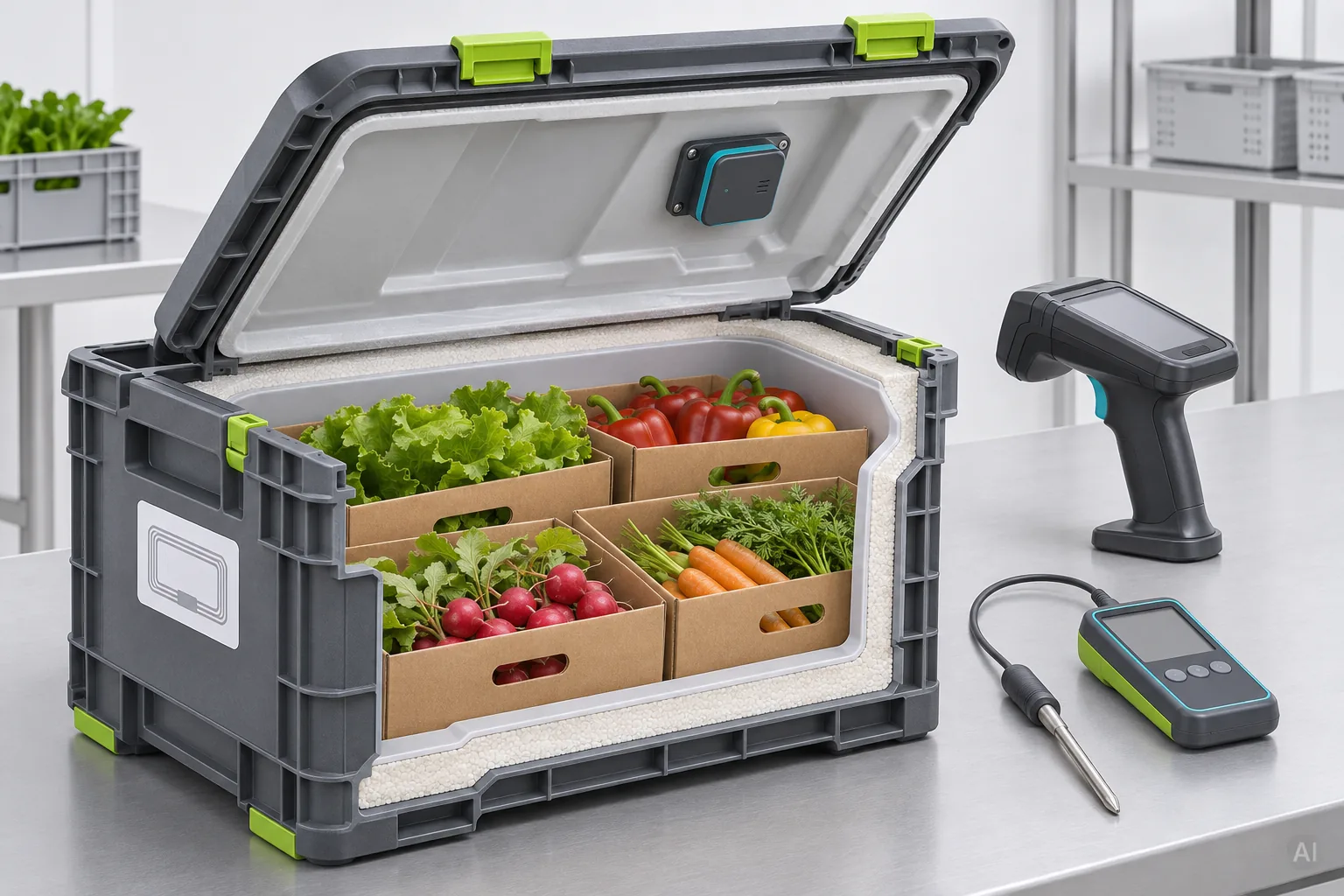
- Object association
- Measurement 08:10
- Reception 08:45
- Assessment with rule version
A delivery is detected at the gate and an application shows a green symbol. For logistics, that may mean the expected container arrived. For quality, the first question is which condition data exists and what the symbol actually authorises. I would start a sensor project with a concrete decision, not the most capable label: what information is needed to accept, hold or professionally assess a delivery?
Identity and measurement need different evidence
An ordinary RFID label does not supply a temperature history. A sensor tag may provide a particular measurement; a logger may store readings over time. Whether measurement and storage occur between reader encounters depends on the chosen solution. Associating a separate logger with an RFID identifier can also be appropriate. A shared display alone does not establish that association.
Define the monitored unit first: individual product, carton, crate, pallet or vehicle zone. A pallet measurement is not automatically evidence for every product on it. If a pallet is split, keep clear which history genuinely applies to which units. A later blanket inheritance must not conceal missing coverage.
Write the requirement before selecting equipment
For one initial product group, I would have quality, transport operations and IT jointly describe the measurement task. Include quantity, position, acceptable uncertainty, reference method, measurement and transmission intervals, and failure handling. The responsible professional function sets product-specific limits and acceptance rules; this article does not replace them.
- Is a current condition at handover enough, or is a history of the entire route required?
- Can measurement take place without reader contact, and where is it stored?
- How are clock, sensor identity and transport object associated?
- How long can transmission be absent before investigation is required?
- Who may finally accept the affected operation?
If the task only concerns identity, sensing may be unnecessary. If documented history is required, a momentary value generated only during interrogation may be unsuitable. This distinction avoids later disagreement over a technically functioning but professionally inappropriate solution.
A data model with two times
In the synthetic dataset, SYN-SENSOR-01 is associated with a transport crate for a limited period. Each record contains object reference, sensor reference, measurement time, reception time, value, unit, quality flag and provenance. Readable test references are not proposed EPC encodings. A different sensor position has its own documented meaning.
For example, a value is measured at 08:10 but transmitted at 08:45. Its position in the condition history is 08:10. Reception at 08:45 still matters because decisions before then lacked that value. Late transmission does not retroactively make an earlier decision fully informed.
A correction must not invisibly replace the original. It retains a reference to the affected measurement, its reason and the responsible change. Sensor replacement and recalibration are also traceable changes. This matters when an unusual history needs subsequent investigation.
Missing data is a condition of its own
A graph can connect two observations despite a long period without measurement. That may be convenient visually; presenting it as proof of continuously acceptable conditions would be misleading. I would show absent measurement, late reception and implausible values separately. An assumed development between observations remains an assumption.
The proposed workflow distinguishes assessable data, data requiring investigation and a professionally established deviation. These are planning categories, not universal food-release rules. An expired calibration reference may require a different response from a confirmed limit breach. Neither should become green merely because an RFID read worked.
Build the pilot against a reference
Limit the first trial to one product group and transport segment. Position the intended solution and a professionally suitable reference so each measurement's meaning remains understandable. If their locations differ, a difference does not automatically mean sensor failure. Position, time resolution and uncertainty belong in the comparison.
For each run, record expected and available measurements, correct association, time deviation, reception delay, missing segments and manual investigations. A controlled outage in a synthetic trial should demonstrate whether the designated person is notified and the affected unit remains clear. The experiment must not bypass any real safety-related acceptance process.
Include restart behaviour too: equipment temporarily offline, values subsequently retransmitted and possibly delivered twice. A stored message needs a stable reference so retrying does not appear as a second independent measurement. Keep original measurement time and later reception visible. This reveals whether software merely collects data or supports a reliable workflow.
A decision is more than an alarm
For every unusual case, the team should know the affected unit, the observation that triggered the flag and the information still missing. The responsible person documents action and reason. An alarm is a request for assessment, not an automatic statement of spoilage or usability. Its absence does not establish food safety when coverage or evaluation is incomplete.
Limits, permissions and change procedures must therefore fit together. When a limit changes, record which rule version applied to which period. A retrospective analysis under another rule must not silently appear to be the original operating assessment. This keeps cause analysis and professional accountability traceable.
Measure benefit at the decision point
Useful measures include correctly associated observations, data available in time, time to a professional decision and effort spent on unresolved cases. Less waste may follow, but is not an automatically measured sensor effect. Without a comparable baseline, it is impossible to distinguish reduced physical losses from changed accounting.
RAIN's 2026 sensor working group is a relevant development initiative. It replaces neither specific datasheets nor professional validation of the application. For my starting point, a small demonstrable decision chain is more valuable than a comprehensive dashboard with unclear meaning.
Next step
Use the companion worksheet for the measurement task, timestamps, data quality and exception ownership. Begin with a segment having a suitable reference and an available responsible function. Explore food and reusable-packaging processes, understand event data or discuss the pilot.
Sources and interpretation
- RAIN Alliance: Sensor Working Group, technical development areas, not validation of this example.
- GS1 EPCIS, interoperable event-data model including sensor information.
- Fields, proposed states and test references are original planning aids. No customer results or universal temperature limits are asserted.