This AI-assisted article was approved by Volker Cesinger. It presents his personal perspective and is not an official Checkpoint Systems publication.
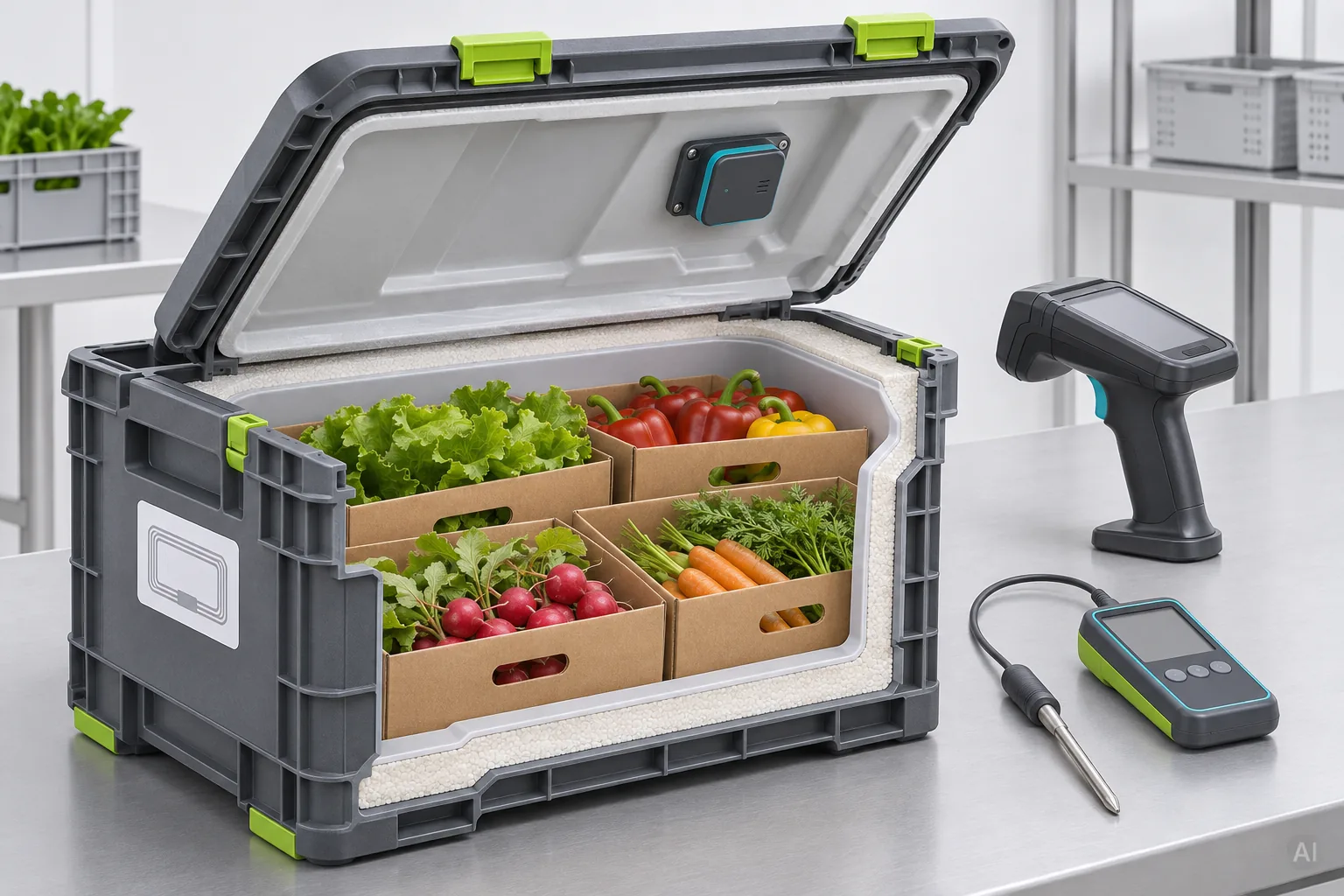
- Identify object
- Associate measurement
- Check timing and quality
- Own the decision
A container is detected at goods receipt. The system knows its identity and associated shipment. That does not establish whether the goods became too warm during transport. The second question requires suitable sensors and traceable measurements. I would define the decision that a measurement should support before choosing the radio technology.
Three different jobs
An ordinary identification label supplies an identifier. Associated master data may reside in a backend, but that does not measure temperature or humidity. A sensor tag combines identity with a particular sensing capability. Its measurement and operating conditions depend on its actual construction.
A logger records measurements over time. Sensing and historical storage are different capabilities: a tag supplying a current value when interrogated does not automatically hold a history of the preceding journey. Power is another separate requirement. Battery-free, battery-assisted and active solutions must each be evaluated against the measurement and communication task.
Separate measurement time from reception time
Consider a synthetic example: software receives a measurement at 10:05 that was taken at 09:50. Assessment of the condition refers initially to 09:50; 10:05 describes data reception. Without measurement time, the application must not present an apparently current condition.
Sensor location also determines what a value means. A point on the outside of a crate does not automatically represent the core temperature of every product inside. Sensor association, mounting position and a professionally suitable reference measurement must agree. Radio communication may work even when the measurement is unsuitable for the intended quality decision.
From a measurement to a decision
I would separate five steps: identify the object, associate its measurement, check timing and quality, apply the appropriate rule, and let the responsible person or system act. That rule also needs an explicit response to missing data. No measurement means neither an acceptable condition nor automatically an unusable shipment.
- Which quantity and measurement range are required?
- When does measurement, storage and transmission occur?
- How are the sensor and actual transport object associated?
- Which uncertainty and calibration are acceptable for the task?
- Who handles a missing or implausible value?
A useful first trial
Start with one container type and a defined transport segment. Compare the intended solution with a suitable reference method. Record missing measurements, incorrect object associations and late transmissions alongside successfully received values. An attractive graph does not replace this cross-check.
The RAIN Alliance announced a sensor working group in August 2026. This illustrates technical development; it does not confirm that every application mentioned is already available or validated for a particular process.
Next step
Write one measurement question: which condition information is required, for which object and time, to support which decision? Then connect that requirement to food and reusable-container identification or discuss a bounded pilot.
Source
- RAIN Alliance: Sensor Working Group, development areas and cooperation, not a product acceptance certificate.