Use case
RF protects at the exit, while RFID can add item context and pattern recognition where tags and processes are prepared for it.
Loss prevention becomes stronger when alarms, deviations and item movements become interpretable events. This use case focuses on merchandise groups with elevated theft or manipulation risk. This use case shows how RF, RFID and RFID as EAS can connect security, transparency and practical store operations.
High-theft ranges are often small, valuable, easy to remove and difficult to control without harming presentation. That is where the difference emerges between inventory that looks correct in a system and a process that actually works in the store, the DC or at checkout.
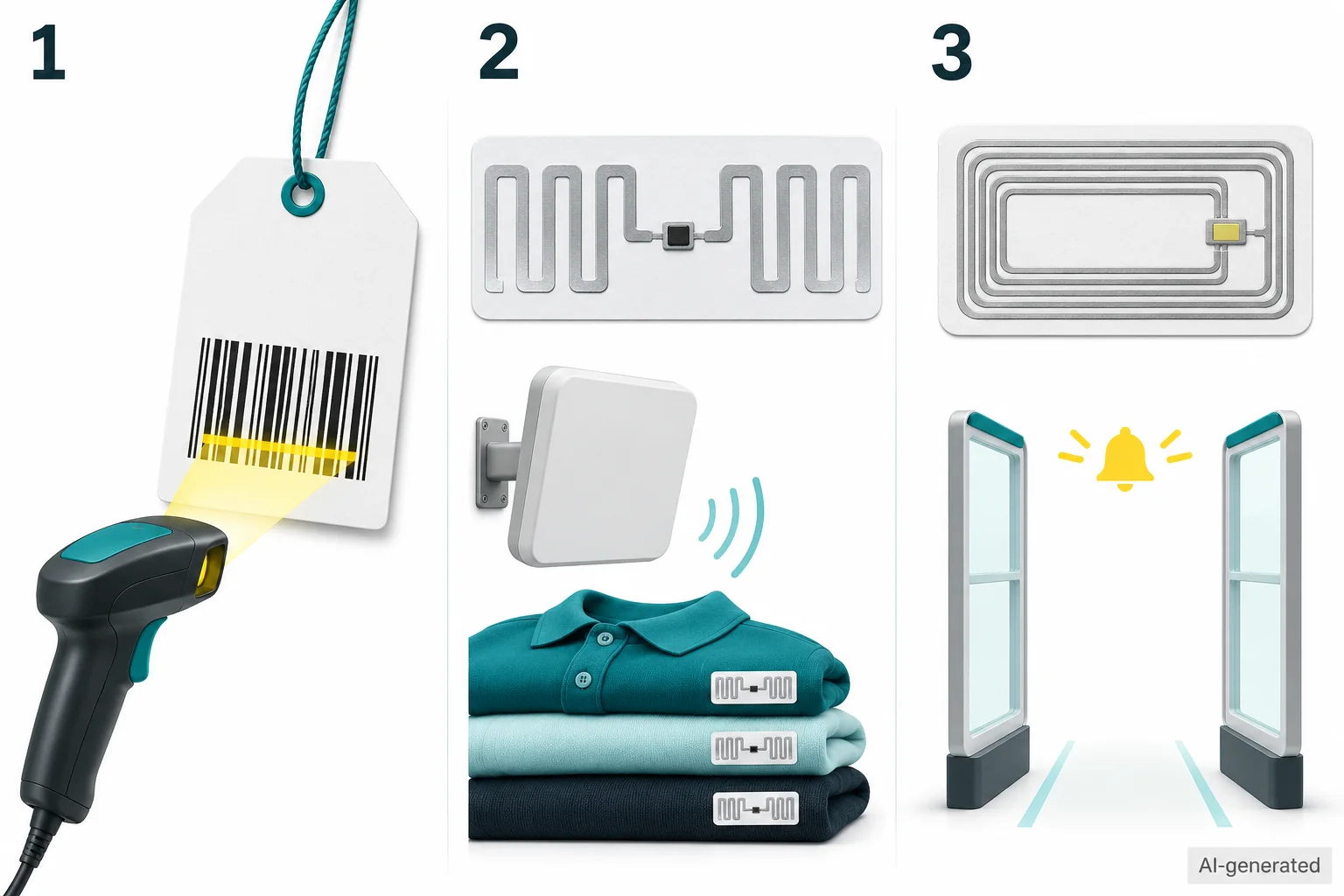 AI-generated illustration
Three capture principles with different roles. AI-generated concept illustration.
Diagram key: Control high-theft ranges
- Barcodes are read optically and can also carry serial numbers.
- UHF RFID combines an identity with radio-based capture.
- Classic RF article surveillance uses a resonant label for an alarm decision, normally without a digital item identity. These are schematic components, not specific product recommendations.
The concrete process value
Loss prevention can focus resources more accurately and manage risk by data rather than assumptions. The use case is therefore not just a technical topic. It affects staff time, process reliability, data quality and the ability to keep merchandise available where it is needed.
Why manual control reaches its limits
High-theft ranges are often small, valuable, easy to remove and difficult to control without harming presentation. In practice, this rarely appears as a single isolated issue. It shows up as repeated friction: teams check again, customers wait, inventory is corrected late or exceptions are only discovered after they have already affected the next process.
Technology building blocks and process logic
For Control high-theft ranges, RFID only creates value when ownership is clear: the read event must trigger a decision, task or exception check that fits the Loss Prevention and EAS workflow.
Risks and prerequisites
Protection, open merchandising and customer experience must be balanced carefully. Retailers should also review assortment, packaging, read zone, data model and the teams involved. For scalable use cases, the decisive factor is not a lab result but stability in the real operating environment.
Project questions to ask
- Which friction around Control high-theft ranges should be reduced first?
- At which process point must the item be read, checked or decided on?
- Which data needs to be available for the RFID information to be useful?
- Who in the store, DC or central team works with the result?
- Which follow-up action for Control high-theft ranges is triggered manually, in software or by a store team?
Useful metrics
Useful KPIs for Control high-theft ranges include:
- shrinkage by merchandise group
- alarm events by SKU
- repeating patterns
- intervention success
For Control high-theft ranges, these KPIs should be captured before the pilot starts. That baseline shows whether the RFID, RF or RFID-as-EAS setup improves the real Loss Prevention and EAS process instead of only producing more data.
Relevant building blocks
Depending on the starting point, this use case may involve:
- RF-EAS
- RFID-EAS
- Alarmdaten
- Store-Training
Recommended entry point
A practical starting point is an RFID readiness check: which items, zones, data and teams are involved? For Control high-theft ranges, a focused start with one product group, a limited number of sites and measurable process targets is usually the best approach. The result determines whether the use case should continue as a pilot, category project or scalable rollout.
Check this use case in your retail process.
Clarify the product range, read zone, label setup, data quality and pilot scope for Control high-theft ranges with rf-id.eu.